Case Study: Building a Local Autonomous AI Agent Runtime with Hermes
Result (Summary)
Deployed and engineered a fully local Hermes Agent (Nous Research) setup on Windows to serve as an autonomous pair programmer and DevOps operator. Built a local OmniRoute Gateway for dynamic model fallback, authored a custom MCP server (edgebot-mcp) for isolated browser automation over Chrome DevTools Protocol (CDP), and designed a 3-tier memory architecture that preserves developer privacy and eliminates hallucination drift.
The Problem
Using cloud-hosted web chatbots (e.g., ChatGPT, Claude Web) creates significant friction during daily hands-on engineering workflows:
- No Local System Access: Inability to inspect local repositories, execute terminal commands, edit source files, or run automated verification tests.
- Context Window Degradation: Repeatedly re-injecting long system prompts and losing working state across sessions.
- Inflexible Tooling Extensibility: Difficult to integrate private homelab services, custom VPS nodes, and internal scripts into standard chat interfaces.
- Privacy & Security Risks: Allowing agents to drive default browser sessions risks exposing active cookies, credentials, and personal browsing profiles.
System Architecture
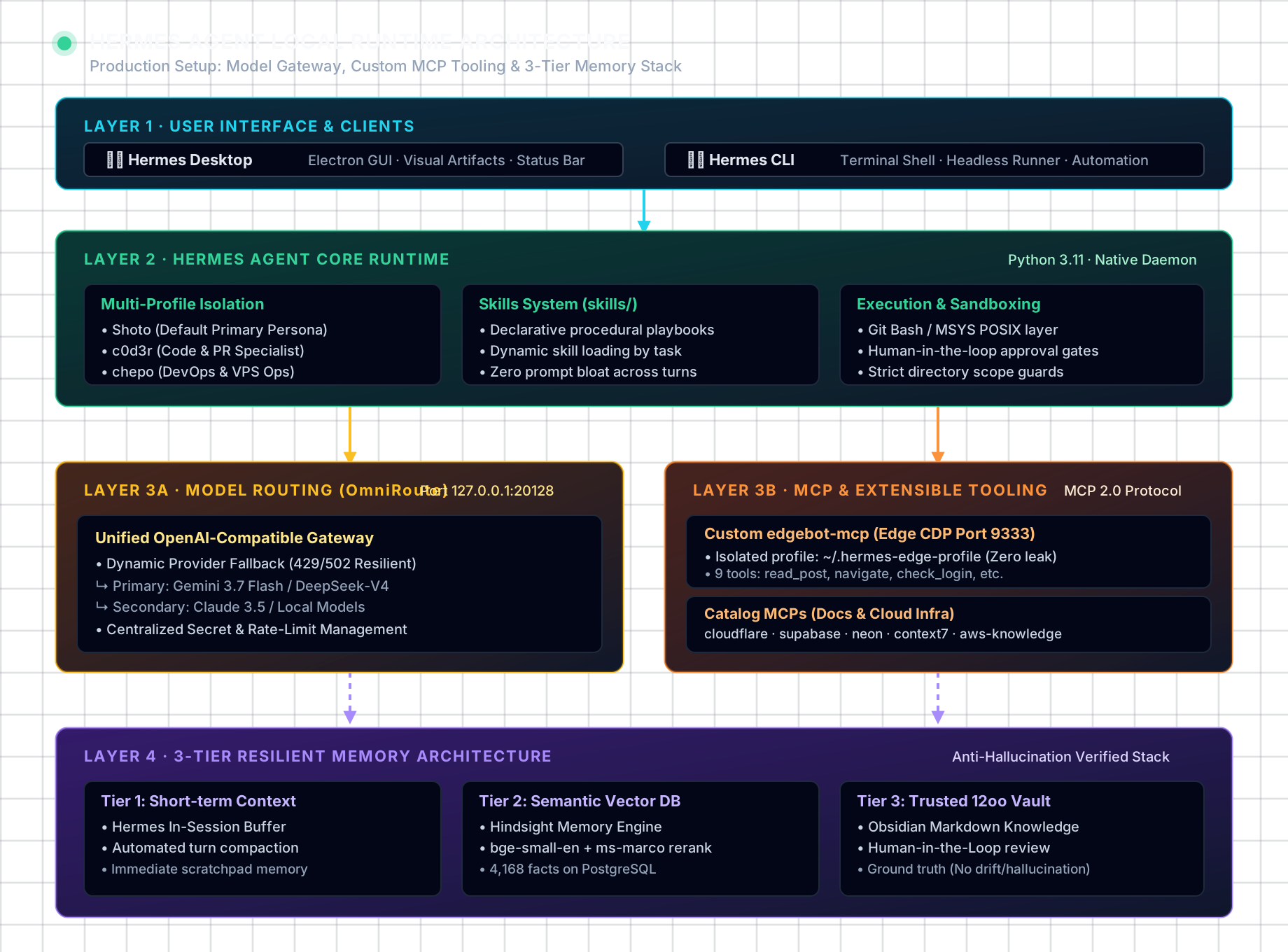
What I Built & Deployed
1. Unified Model Routing via OmniRoute
- Configured OmniRoute Desktop as a local API gateway listening on
127.0.0.1:20128. - Serves as an intelligent routing proxy across multiple LLM backends (Gemini 3.7 Flash, DeepSeek-V4, Claude) with automated fallback policies to handle upstream 429/502 outages seamlessly.
2. Custom MCP Server (edgebot-mcp)
To enable agent-driven web automation and data extraction without touching the primary browser environment:
- Architecture: Authored in Python using the
mcp 2.0specification, communicating natively over Chrome DevTools Protocol (CDP) WebSockets. - Strict Isolation Boundary: Launches a dedicated Microsoft Edge instance on isolated debugging port
9333with a dedicated user profile (~/.hermes-edge-profile). Enforces complete isolation from the primary Brave/Chrome browser on port9222. - Exposed Tools:
launch_browser,check_login,navigate,read_page,read_post,read_group_feed,expand_content.
3. 3-Tier Memory Architecture & Homelab Distributed Plane
| Memory Tier | Subsystem | Function & Scope |
|---|---|---|
| Tier 1: Short-term | Hermes Context Buffer | Session scratchpad, active terminal buffers, and prompt compression budgets. |
| Tier 2: Semantic Memory | Hindsight Engine | Automated cross-session memory recall via local embeddings (bge-small-en-v1.5) and cross-encoder reranking (ms-marco-MiniLM-L-6-v2). |
| Tier 3: Trusted Vault | 12oo (Obsidian Markdown) | Human-in-the-loop reviewed knowledge base acting as the single source of truth to prevent model hallucination drift. |
Distributed Homelab Migration: To eliminate resource contention on the primary laptop, the Hindsight Data Plane (PostgreSQL 18 + 4,100+ facts) was migrated to a Headless Homelab PC (
192.168.1.137) via an SSH Reverse Tunnel (-R 20128:127.0.0.1:20128). This reclaimed ~1.3 GB of host RAM while providing high-speedlocal_externalmemory recall over LAN.
4. Voice-to-OS Subsystem (Fast System 1 Intent Routing)
Engineered a sub-200ms Thai/English voice-to-desktop command loop:
- Dual-Backend STT: Supports local Faster-Whisper (CUDA on RTX 4050, ~1.5GB VRAM) and cloud Groq Whisper Turbo (0 MB VRAM) with automatic fallback.
- Zero-Hallucination Intent Router: Leveraged Groq LPU (
gpt-oss-20bwith Strict JSON Schema) executing in ~120ms. Dynamically indexes 155 desktop applications from the Windows Start Menu, guaranteeing zero-hallucination app launching while preserving >4.1GB of GPU VRAM for development workloads.
Technical Challenges & Solutions
1. MCP SDK 2.0 Breaking Changes & Schema Inference
- Challenge: The
mcp 2.0Python SDK deprecatedFastMCP. Wrapped handler functions utilizing**kwargscaused the schema generator to produce invalid parameter signatures (Field required: kwargs). - Solution: Migrated to low-level
MCPServerregistration and appliedfunctools.wrapson tool handlers to ensure clean Pydantic schema extraction directly from the underlying function signatures.
2. Edge CDP WebSocket Origin Validation
- Challenge: Edge v111+ rejected incoming WebSocket handshakes from localhost with a
WebSocketBadStatusException 403. - Solution: Injected
--remote-allow-origins=*alongside dedicated--user-data-dirflags upon launching the isolated browser process from the MCP daemon.
3. Windows Path Resolution & Line-Ending Normalization
- Challenge: Running under Git Bash (MSYS) introduced path resolution mismatches between native Windows paths (
C:\...) and POSIX paths (/c/...), alongsideCRLFvsLFmismatches during automated content extraction. - Solution: Enforced native Windows absolute paths for external binary invocations and added payload line-ending normalization prior to string verification gates.
Key Learnings
- Agent Reliability Depends on Tool Guardrails: Model intelligence is only half the equation; system stability comes from robust tool contracts, deterministic error handling, and strict permission boundaries.
- Environment Isolation is Essential: Running automated tasks inside isolated browser instances and dedicated network ports guarantees safety without risking production or personal credentials.
- Never Rely on Unvalidated AI Memory: Separating automated semantic capture (Hindsight) from human-reviewed ground truth (Obsidian 12oo) completely prevents hallucination loops.
Tech Stack
Hermes Agent Core, Python 3.11, Model Context Protocol (MCP 2.0),OmniRoute Gateway, Chrome DevTools Protocol (CDP), WebSocket,Hindsight Memory Engine (PostgreSQL + BGE Embeddings), Git Bash, Windows 11Lessons (FAQ)
Why choose Hermes Agent over conventional AI coding extensions? Hermes functions as an extensible autonomous runtime at the OS level—capable of executing declarative skill workflows, coordinating multiple MCP servers, and orchestrating complex multi-turn background tasks.
How is security maintained across files and credentials? We enforce a strict human-in-the-loop protocol: credentials are never echoed into prompts, sensitive configurations require interactive approval gates, and autonomous actions remain strictly confined to designated project directories.